I began my PhD in Fall 2025 in applied cryptography. I have been fascinated by cryptography for a long time, but somewhere along the way, I forgot why.
Around seasoned cryptographers, I found myself hesitating. I felt like an impostor. My mathematical self-doubt was acute. I felt like one of those kids who says they “like math” only because they can complete textbook exercises, too embarrassed to admit I genuinely appreciate the theoretical approach, the rigor, and the proofs, even if I struggle with them.
At the same time, I knew I could never be satisfied with quick-fix ideas that only imitate security. I knew I did not want to hide behind surface-level answers like “just add a rate limiter” or “maybe steganography can do it.” What drew me in was something deeper.
Listening today to a talk by Shafi Goldwasser, the 2012 Turing Award winner, I remembered that deeper reason. Cryptography is not just beautiful because it is rigorous. It is beautiful because it gives us the power to trust technology while staying fully aware that adversaries exist.
I know that anyone could be snooping on my chats, and yet I trust that they cannot actually read them, thanks to cryptography. That trust is not vague. It is rigorously defined. I know the assumptions under which my communication is secure. And if the security were ever to fail, I would know exactly why it failed.
Cryptography is precise: the security of a system is stated as guarantees under specific assumptions. To attack the system is to show that one of those guarantees does not hold. For many schemes, breaking that guarantee would imply solving a really hard problem. In that framing, breaking the system is not just “finding a hack.” It can mean either that the underlying “hard” problem was not so hard after all, or that the assumptions were either incorrect or incomplete.
Just a few months before beginning my PhD, I had a dream. I did not just want to research cryptography. I wanted to learn it in such a way that I could make it accessible to middle schoolers. Yes, I want to write a book called Cryptography for Middle Schoolers.
I want to introduce the core ideas of cryptography intuitively, without fancy notation and without making the subject feel like it belongs only to a small elite circle. A lot of people do try to simplify cryptography, but I do not think they usually have middle schoolers in mind. Maybe that is too ambitious. But I think holding onto that ambition will keep me grounded. What is science, after all, if it cannot be communicated? If it cannot inspire children?
I have grown tired of the way “mathematical maturity” is sometimes used as a gatekeeping phrase, as if wonder, curiosity, and intuition are unsophisticated notions. I do not want cryptography to feel unreachable.
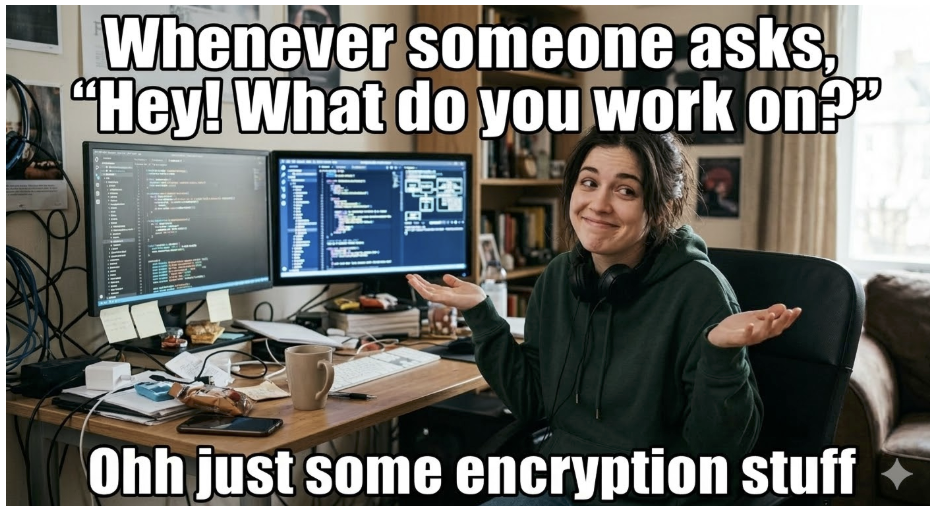
There are many obstacles between me and this dream. For one, I think I am actually a terrible communicator. My understanding of the field still feels scattered. My impostor syndrome makes me under-communicate and under-sell what I do.
This has to stop.
I had a poetry blog in high school, and later a poetry blog as a young adult. This post feels like the beginning of the next phase of my life: a technical blog that will push me to communicate better, think more clearly, and get a tiny bit closer to that dream of Cryptography for Middle Schoolers. If I keep showing up here, writing honestly and trying to explain things simply, maybe one day that book will not feel so far away.